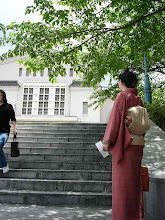
Thursday, 24 April 2008

Furisode (振袖)

Furi-sode (振袖) is the prime ceremonial cloth for unmarried women among kimonos. Furi (振) means 'swing' and sode (袖) means 'sleeves.' So Furisode has longer sleeves than the other kimonos.

Parents of Japanese girls used to make a set of Furisode for their daughters when girls became 20 years old. And the girls wore it for coming-of-age ceremonies. Now not so many parents do that. Some wear western dresses, and some rent Furisode from shops.

But I LOVE 振袖♡

I can only wear it when I'm single! (Well, physically I can wear Furisode after I get married, but it's strange.) So my sister & I wore it for our cousin's wedding party♬


My parets got these Furisodes made for our coming-of-age ceremonies. They are same cloth in different colours.


They look unpatterned, but actually they got white dots(゚∇^*)! A fabric-dyeing artist sprinkled with wax before dyeing. After that, he washed the cloth, then un-dyed spots remain white.


The back of Obi belt (帯) can be tied in may shapes.


Can you see that the shapes of my sister's and my Obis are different? It's like Origami. We asked a professional kimono dresser to get us dressed.


She had such a wonderful technique, and made those shapes so quickly♥ I want to wear Furisode by myself, but you'd see it's not so easy! I don't think I can make those shapes on my back(>▽<;

Friday, 18 April 2008

Night view of Cherry blossoms (夜桜)

We Japanese love watching cherry flowers at night.
It's called 夜桜 viewing.

夜桜 literally means night (夜) cherry flowers (桜).

Here are the real 夜桜 photos. ;)


Sorry they are not good ones.
It's very difficult to take nice photos of 夜桜!

Anyway, we Japanese love going to see cherry flowers at night. And many of us bring food and drinks to enjoy them under the cherry trees. So if you visit parks famous for 桜 during the cherry season, you may see some people go crazy drinking too much beer.

But seeing real cherry flowers is not only way to enjoy 桜. I take a tea ceremony lesson every week, and my teacher prepares special sweets for us. Those sweets express flowers or sceneries of the season. This week, they were cherry flowers!


Aren't they beautiful!? Every time when I open a sweet case, I get excited!! It's one of the best moments during the tea ceremony... (whoops, my mistake! The best moment must be when I start eating.)

Monday, 7 April 2008

So now it's time for Cherry blossom viewing!!

Today it's raining here in Western Japan.
I'm sorry for full-bloomed cherry(桜) blossoms.

But I did all my enerty to enjoy beautiful cherry flowers last weekend♡♡♡ I have nothing to regret:)


This is Weeping Japanese Cherry, and it seems like a (pink) waterfall.


This one is Somei Yoshino (Prunus yedoensis.) Very popular & common kind of cherry now. I felt I was dreming when I saw this scenery. Flowers were moving like waves in the blue sky. 'Beautiful' wasn't enough to express the moment.


Woops, don't forget to see cherry branches with a river (water)! They make the best match♥


Oh, YES!! Now it's time for wearing kimono♬

Tuesday, 25 March 2008

Plum blossom viewing

Long, long time no update!!
Last time I said 'Happy New Year!' and now it's a time to see
beautiful flowers all over the places.
Plum(梅) blossoms season is almost over, and now we expect
our National flower, cherry blossoms(桜) will come to bloom.

Well, now when we say 'bloom gazing(花見),' it means
we go to see cherry blossoms.
However, a thousand years ago, it meant '梅見',
enjoying plum blossoms.

I think, 梅 is more like teenage girls,
and 桜 have charms of elder ladies.


梅(plum) are lovely and smell very nice.
They cheer me up.


On the other hand, 桜(cherry) has mysterious beauty.
It might be said 'sensual.'

I'll update photos of cherry blossoms when the season comes.
Hope you compare those photos and let me know your impression. ;)

Monday, 14 January 2008

Hatsu-moude (初詣)

Hatsu-moude (初詣)is the first visit of the year to a shrine.
'Hatsu’ means ‘first’ and ‘moude’ means ‘to go to worship.’

Many Japanese visit a shrine on the New Year's Day.
Some wait in a shrine from the night of New Year's Eve,
and go to worship as soon as a new year starts.


The red arch in the above photo is called 'Torii(鳥居),' and this is a symbol of Japanese shinto shrine. (So Buddism temples don't have it.)


When we visit a shrine, many of us take a fortune slip called 'Omikuji (おみくじ)'. It costs about 100 yen to 200 yen (50p to 1 pound.)
The Omikuji I took this year is this.
It tells about my life, health, love, etc of this year.
This year, my Omikuji was good one saying that my dreams come true, I would meet a nice guy!! So I kept it with me.


If you pick bad one and are not happy with it, you tie it with a branch of the shrine.
It means you leave your bad luck there.

We Japanese love fortune-telling and trying to check our own lucks.

Friday, 11 January 2008

Happy 2008!!

Long time no updating...(-"-;A
Hope your 2008 be a lovely one!!


Well, I visited a bottega (craft center) of an embroider in Kyoto.
He's one of the best know embroiders in Japan, and famous for
specializing in Noh costumes.


Aren't they beautiful?! I got trembled when I saw them!
Of couse, they both were all handstitched.

Nowadays, we live in 'easy, instant same, cheaper is better' world. But seeing these artistic costumes, I felt we shouldn't lose this kind of cultures.


The world would be so boring if we wear same clothes and have same pictures in our rooms. I wish wonderful Japanese culture keeps going on, and your wonderful cultures do, too. ☆^(o≧▽゚)o

Wednesday, 12 December 2007

Japanese autumn


Is it too late to talk about autumn?
Oh, well, never mind! I can't help talking about this place.

I visited a templed called 廣誠院 (Kou-sei-in temple) on December 1st.

This traditional Japanese house is just behind Kyoto Kyoto Hotel Okura.
This year we had very warm autumn, so it was the best time to see
coloured leaves in Kyoto. (Normally it's the middle of November.)


Can you believe it? When I entered the state room (大広間),

this scenery came into my eyes!!


This temple, built in 1892, used to be a villa of Kanetsune Ijuin.
He was Samurai before Meiji restoration, but after that became a businessman.
You can imagine how rich he was when you know he kept building more than 10 houses and villas! He only lived in this house for 4 years. What a happy man!!


The state room faces a pond. As the floor is raised, I felt this room was in the air.


This house has a very small room for tea ceremony. And it also looks like floating in the air.


The scenery from the circle window in the tea room was astonishing...

We can only enjoy the colour of autum for about 1 week at a place. So we feel it's precious and that's why we love it, isn't it?


I wouldn't forget these sceneries for many, many years to come.