Friday, 3 July 2009


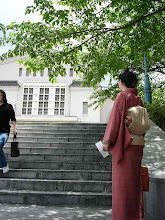
Mimurotoji Temple is a temple

in Uji area which is famous for

having two of the world heritage sites,

the Phenix Hall of Byodoin Temple

and Uji-gami shrine.


Mimurotoji Temple is an honorary head temple of Honzan-Shugen-shu sect and was founded in the late 8th century.

There is an interesting story as the origin of this temple. It is said that one night Emperor Konin (709-781) found a light thrown from Uji area, so he dispatched an officer to find the source of the light. Then the officer found a image of Bodhisattva (Kannon) in the stream of Shizu river. Emepror Konin founded a temple to enshrine the image, and it's now called Mimurotoji temple.

Mimurotoji Temple is known as 'Flower Temple.'


The garden has 20,000 azaleas & 1,000 alpine roses which bloom from end of April to early May. In June, we can enjoy 10,000 hydrangeas in bloom come out. After hydrangeas, lotus flowers in 250 pots show their beautiful pink flowers. :D


Oh, here is a early bloomer of lotus.


Now Japan is in the rainy season and it means it's a time of hydrangeas.


I guess you don't need too much explanation. ;P
Please enjoy the beautiful flowers♪


To get this temple, take a public bus from either JR or Keihan Uji station. Or take Keihan line to Mimuroto station, then then 15 minutes on foot.

If you stay near Kyoto station, take JR. But if you're in the east part of Kyoto city such as Gion, Shijo, Shichijo, Higashiyama area, I recommend you to take Keihan line. Transfer @Chicho-jima. :)


Uji is a place of tea plantation. You will find lots of cafes & shops which offer you green-tea icecream! Walking from Mimuroto station to Mimurotoji temple made me enjoy the icecream even better. Bon Appetit★

Wednesday, 1 July 2009

Iris ensata@Shirokita Park

Long time no see...

It's too late to talk about Iris ensata, but let me introduce you a nice park to visit in Osaka to see it. In Osaka, we can enjoy Iris ensata (a kind of Japanese iris) in bloom from mid May to mid June.


Shirokita park is a city park in east part of Osaka city. If you take a bus from Osaka station, it takes approx 20 minutes to Shirokita Park bus stop.

While irises are in full bloom, the park opens its Iris garden. (Admission @200yen per person).


This year, the iris season is over... I will (probably) inform you on the blog when the opening period is announed next year! :D

Tuesday, 12 May 2009

Iris swamp @Ota shrine


I visited Ota shrine near Kamogamo shrine a few days ago.

(To see a map, refer to Kamigamo shrine HP)


Ota shrine is a sub-shrines of Kamigamo shrine which is one of the world heritage sites in Kyoto.

The deity of Ota shrine is Amenouzume who is known as a god of dancing & performing arts.


This small shrine is visited by many people only in this season...why??


Because of its famous iris swamp.


A poem to adremire the beauty of this iris swamp was read in 12 century, so this scenery has been seen for more than 800 hundred years!!

The irises start blooming in the biginning of May every year, and flowers can be enjoyed for about 2 weeks.


Now this iris swamp was designated as a national protected species in 1939.


The contrast of green & purple is gorgeous!


I shouldn't write too much explanation... maybe just photos are enough.


Hope you can feel the beauty of this scenery. ;P 


Monday, 27 April 2009

Hanami @Ninna-ji Temple (仁和寺)

Ninnaji(仁和寺) is one of 17 world heritage sites in Kyoto. It was founded in 888, but, like most historic buildings in Kyoto, it suffered repeated destruction in wars and fires over the centuries.

Ninnaji used to be a monzeki temple, which has an abbot (top priest) from the imperial family by tradition. This tradition was over in Meiji period (about 100 years ago.)


In the map, red circle is where Ninnaji-is and blue circle shows Kyoto station.

Ninnaji(仁和寺) is one of my favorite temples in Kyoto. ;D It's nice to visit here anytime in a year, but this temple is famous for having a beautiful cherry garden in their backyard.


This cherry garden is noted for a rare, locally cultivated type of cherry tree, named Omuro Cherry. The blossoms of Omuro cherry trees open relatively late in a hamami season (usually a week later than other kinds of cherries.)


You may have noticed that Omuro chrry trees are lower than other kinds.


For example, this is a weeping cherry tree in Arashiyama.

You can see a person taking a photo on a left-hand-bottom corner a bit. :D

This is one of the reasons many people visit this special cherry garden every year.


In Kyoto, some people tease a girl with a button nose by calling her 'You are a Omuro cherry' because in Japanese we have a homonymous word 'hana' for both 'flower(花)' and 'nose(鼻).'

Oh, well, it's not bad to be like Omuro cherries, is it? They are so beautiful!!

Thursday, 23 April 2009

Hanami @Heian Shrine (平安神宮)

Hanami (花見) literally means 'flower viewing', but in Japan now it means 'viewing chrry blossoms in blooms.' Last year I put some photos of Philosopher's path & Gion. This year I introduce you other famous spot for cherry flowers. ;D

Let me talk about Heian Shrine today.

Heian Shrine is Shinto shrine (Shinto is Japanese original religion) was built in 1895 for the 1,100th anniversary of the establishment of Kyoto. So it's a pretty new shrine in Kyoto. Its main building is designed to imitate the main office of the original Kyoto Imperial Palace built in 8th century on a three-fourth scale.

The shrine is dedicated to Emperor Kanmu (the 50th) and Emperor Kōmei (121st). The former moved the capital to Kyoto, and the latter was the last emperor who lived in Kyoto as his son Emperor Meiji moved the capital to Tokyo.

Well, maybe it's too much explanation... I shall talk about the garden. Heian Shrine has a gorgeous garden famous for weeping cherry trees behind the main building.


Weeping cherries @Heian shrine are known for their bright colour.


This is a colour of weeping cherry we normally think of.


You can see the colour of flowers @Heian Shrine is much stronger.


The garden of full of pink, and full of people in this season.


It's said that there are more than 600 hundred kinds of cherry trees in Japan.

The number is growing each year due to breed improvement & find of new breeds.


Here you find about 10 kinds of different cherries including green cherry. :D


'Cherry flower & water' are our favorite scenery. We never get bored of seeing cherry blossoms in blooms, though we see them every year.

Tuesday, 21 April 2009

Tea experience @Ran Hotei (らん布袋)


If you walk 5 minutes from Nijo Castle in Kyoto, you'll find a small cafe called 'Ran Hotei' (sorry, but only in Japanese) in Sanjo Shopping Street. This machiya cafe (machiya=町屋 are traditional wooden townhouses found a lot in Kyoto) is a place where you can experience Japanese tea ceremony. (2,500yen per person & advance reservation required.)


The grand floor is a cafe space. So you may not believe you can learn about tea ceremony here. But when you go up to the first floor, you find table-style tea ceremony space.


A formal tea ceremony is held in a room with tatami mats, but these days even Japanese people find it difficult to sit on tatami floors for a long time.

Here, you can see tea ceremony and ask questions sitting on a chair.


But before start, we go downstairs and visit the small garden in the back.


This garden with wooden bench is a waiting place. We come & wait here till the ceremony starts, but it's also a place where we forget our daily life and get ready for the ceremony.

Here, our host, Mr. Randall Channell explains what tea ceremony is, and brief procedures of tea ceremony and so on.

I shall call him 'Randy sensei' from now on. 'Sensei=先生' means 'teacher' or 'instructor' in Japanese.


Randy sensei is Canadian, and he started his tea study in 1985 and and received his first teaching license in 1996. He often shows up in media including TV and is pretty famous now throughout Japan. For more details of his life, please check his homepage.


After hearing his explanation and having Q&A Time, we go back upstairs. Then there waiting lovely sweets. Can you guess what the motif is? It's a Japanese medlar (枇杷)!! Sweets are definitely one of the most enjoyable things in tea ceremony (for me. ;P)


And now, he starts making tea. This tea making procedures is called 'otemae=お点前.' We see his otemae enjoying the sweets. If we have any questions, we are free to ask.


Even in Kyoto, there are a few places we can experience tea ceremony in English. Randy sensei is a native English speaker & an associate professor of Urasenke school. To solve your questions about tea ceremony, this is a right place to come.


Woops! Who is it?

Well, you can actually make a cup of tea by yourself @Ran Hotei.


After the tea ceremony, my friend and I stayed nearly an hour at cafe downstairs. (Yes, I must admit I have a piece of chocolate green tea cheese cake.) This cafe has both tatami space and table & chair space.


Although this building was totally renovated, you still find origina beams and walls. A Japanese old machiya & art deco decoration matched well.


And it's fun to see antiques. This is a stair-type drawer or stairs with drawer function?? I don't know what you call it in English. If you have any ideas, please let me know!!

Tuesday, 3 March 2009

Doll's Festival (雛祭り)

Today March 3rd is the day of Doll's Festival (雛祭り=Hinamatsuri) in Japan. It's also called the Girls' Festival as we specially pray for young gir's growth and happiness on this day.


Many families with girls display special dolls for this festival & dedicate peach blossoms to them. They are usually arranged on a five or seven-tiered stand covered with a red carpet because odd numbers are considered to be lucky numbers. This is the set of the dolls displayed at Kyoto Brighton Hotel.


At the top are the Emperor and Empress. The next step contains three court ladies followed by five musicians, two ministers, and three servants ending the bottom row in a five-tiered display. (In these photos, it's hard to see the ministers though...)

There are also small pieces of furniture, small meal dishes, and other things.


However, these days many families in Japan live in small apartments or houses, and they don't have enough space to display a huge doll set. So it's more common now to display the Emperor and Empress only.


These dolls were made by my friend. Can you guess what they are? Eggs!!! She is so clever & artistic ! And the dolls are so cute. ;D It's fun to look for many, different Hina dolls during this season in Japan. Each of them has a different & unique face.


Another name for this festival is Peach Festival (Momo no sekku) because of the peach blossom season on the old lunar calendar. So we see peach flowers everywhere around the this festival, and feel the spring is coming.


The origin of Hinamatsuri is an ancient Chinese practice in which the sin of the body and misfortune are transferred to a doll, and then removed by abandoning the doll on a river. Though the festival was originally for both boys and girls, it is now just for girls. The idea of dolls must have matched of lovely girls.


They are the sweets surved at my tea ceremony school last week. The mottif is the dolls (the Emperor & Empress)!


And the mottif of diamond-shaped sugar sweets is "Hishimochi" which you can see in the first photo. They are colored rice cakes, and all of the colors, red (or pink), white and green have meanins. The red is for chasing evil spirits away, the white is for purity, and the green is for health or long life.


Well, this festival is for YOUNG girls, but who cares? Happy Girls Day for GIRLS in all over the world!! And boys! Don't worry we have Boys Festival on May 5th. (3/3 and 5/5... you know how much we the Japanese love auspicious stuffs!)