Sunday, 5 July 2009

Moss Garden.... Saihoji Temple (西芳寺)

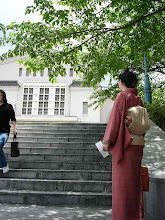
In the end of June, I visited Saihoji Temple known as Moss Garden, which is one of the 17 properties of the World Heritage Sites registered as "Historic Monuments of Ancient Kyoto".

However, this temple is not a 'sightseeing temple.'

Advanced reservations required by a Japanese reply postal card. So if you're not a resident in Japan, you'd better ask a travel egency to make a reservation for you.
(If you want to do it by yourself, let me know. I can tell you how to. :D )

And admission fee @3,000 yen per person (30USD) is not cheap. This includes a fee to join a Buddhism ceremony to chant & copy Buddhist sutra. At this temple, joining the ceremony is of principal importance and seeing the garden comes in the second place.


Well, let me tell you a little bit of the history of this temple.

Although there's a lack of any conclusive evidence, but it is said there used to be a villa of Prince Shōtoku in the early 7th century. And about 100 years later, Priest Gyoki , who exerted himself for construction of the Great Buddha of Nara, founded a temple of Hoso sect in 8th century.


It was devastated in 14 century, but a famous landscaper Muso Kokushi refurbished it in 1339.


Now it is said that more than 120 species of moss are flowing over the ground in the central garden.


The amazing thing is....


...it was never planned to be covered in moss.


It is considered this scenery was born in 18th to 19th century. Now we can enjoy what Muso Kokushi could not see or imagine. ;P


The garden of Saihoji Temple is divided into two parts. One the circuit-style with woods and pond while the other is the stone garden style.


The circuit-style part has a pond in the shape of '心(kokoro)' , the Chinese character meaning 'heart' or 'mind'. So carefully watching this garden may lead you to reexamine yourself.


The stone garden is halfway up a hill.


And this is thought to be the first dry garden in Japan.


All the Japanese stone gardens including the famous rock garden at Ryoan-ji may not be seen without this garden as an example.

This garden is said to signify the water flow of waterfalls. Can you imagine that??

Friday, 3 July 2009


Mimurotoji Temple is a temple

in Uji area which is famous for

having two of the world heritage sites,

the Phenix Hall of Byodoin Temple

and Uji-gami shrine.


Mimurotoji Temple is an honorary head temple of Honzan-Shugen-shu sect and was founded in the late 8th century.

There is an interesting story as the origin of this temple. It is said that one night Emperor Konin (709-781) found a light thrown from Uji area, so he dispatched an officer to find the source of the light. Then the officer found a image of Bodhisattva (Kannon) in the stream of Shizu river. Emepror Konin founded a temple to enshrine the image, and it's now called Mimurotoji temple.

Mimurotoji Temple is known as 'Flower Temple.'


The garden has 20,000 azaleas & 1,000 alpine roses which bloom from end of April to early May. In June, we can enjoy 10,000 hydrangeas in bloom come out. After hydrangeas, lotus flowers in 250 pots show their beautiful pink flowers. :D


Oh, here is a early bloomer of lotus.


Now Japan is in the rainy season and it means it's a time of hydrangeas.


I guess you don't need too much explanation. ;P
Please enjoy the beautiful flowers♪


To get this temple, take a public bus from either JR or Keihan Uji station. Or take Keihan line to Mimuroto station, then then 15 minutes on foot.

If you stay near Kyoto station, take JR. But if you're in the east part of Kyoto city such as Gion, Shijo, Shichijo, Higashiyama area, I recommend you to take Keihan line. Transfer @Chicho-jima. :)


Uji is a place of tea plantation. You will find lots of cafes & shops which offer you green-tea icecream! Walking from Mimuroto station to Mimurotoji temple made me enjoy the icecream even better. Bon Appetit★

Wednesday, 1 July 2009

Iris ensata@Shirokita Park

Long time no see...

It's too late to talk about Iris ensata, but let me introduce you a nice park to visit in Osaka to see it. In Osaka, we can enjoy Iris ensata (a kind of Japanese iris) in bloom from mid May to mid June.


Shirokita park is a city park in east part of Osaka city. If you take a bus from Osaka station, it takes approx 20 minutes to Shirokita Park bus stop.

While irises are in full bloom, the park opens its Iris garden. (Admission @200yen per person).


This year, the iris season is over... I will (probably) inform you on the blog when the opening period is announed next year! :D

Tuesday, 12 May 2009

Iris swamp @Ota shrine


I visited Ota shrine near Kamogamo shrine a few days ago.

(To see a map, refer to Kamigamo shrine HP)


Ota shrine is a sub-shrines of Kamigamo shrine which is one of the world heritage sites in Kyoto.

The deity of Ota shrine is Amenouzume who is known as a god of dancing & performing arts.


This small shrine is visited by many people only in this season...why??


Because of its famous iris swamp.


A poem to adremire the beauty of this iris swamp was read in 12 century, so this scenery has been seen for more than 800 hundred years!!

The irises start blooming in the biginning of May every year, and flowers can be enjoyed for about 2 weeks.


Now this iris swamp was designated as a national protected species in 1939.


The contrast of green & purple is gorgeous!


I shouldn't write too much explanation... maybe just photos are enough.


Hope you can feel the beauty of this scenery. ;P 


Monday, 27 April 2009

Hanami @Ninna-ji Temple (仁和寺)

Ninnaji(仁和寺) is one of 17 world heritage sites in Kyoto. It was founded in 888, but, like most historic buildings in Kyoto, it suffered repeated destruction in wars and fires over the centuries.

Ninnaji used to be a monzeki temple, which has an abbot (top priest) from the imperial family by tradition. This tradition was over in Meiji period (about 100 years ago.)


In the map, red circle is where Ninnaji-is and blue circle shows Kyoto station.

Ninnaji(仁和寺) is one of my favorite temples in Kyoto. ;D It's nice to visit here anytime in a year, but this temple is famous for having a beautiful cherry garden in their backyard.


This cherry garden is noted for a rare, locally cultivated type of cherry tree, named Omuro Cherry. The blossoms of Omuro cherry trees open relatively late in a hamami season (usually a week later than other kinds of cherries.)


You may have noticed that Omuro chrry trees are lower than other kinds.


For example, this is a weeping cherry tree in Arashiyama.

You can see a person taking a photo on a left-hand-bottom corner a bit. :D

This is one of the reasons many people visit this special cherry garden every year.


In Kyoto, some people tease a girl with a button nose by calling her 'You are a Omuro cherry' because in Japanese we have a homonymous word 'hana' for both 'flower(花)' and 'nose(鼻).'

Oh, well, it's not bad to be like Omuro cherries, is it? They are so beautiful!!

Thursday, 23 April 2009

Hanami @Heian Shrine (平安神宮)

Hanami (花見) literally means 'flower viewing', but in Japan now it means 'viewing chrry blossoms in blooms.' Last year I put some photos of Philosopher's path & Gion. This year I introduce you other famous spot for cherry flowers. ;D

Let me talk about Heian Shrine today.

Heian Shrine is Shinto shrine (Shinto is Japanese original religion) was built in 1895 for the 1,100th anniversary of the establishment of Kyoto. So it's a pretty new shrine in Kyoto. Its main building is designed to imitate the main office of the original Kyoto Imperial Palace built in 8th century on a three-fourth scale.

The shrine is dedicated to Emperor Kanmu (the 50th) and Emperor Kōmei (121st). The former moved the capital to Kyoto, and the latter was the last emperor who lived in Kyoto as his son Emperor Meiji moved the capital to Tokyo.

Well, maybe it's too much explanation... I shall talk about the garden. Heian Shrine has a gorgeous garden famous for weeping cherry trees behind the main building.


Weeping cherries @Heian shrine are known for their bright colour.


This is a colour of weeping cherry we normally think of.


You can see the colour of flowers @Heian Shrine is much stronger.


The garden of full of pink, and full of people in this season.


It's said that there are more than 600 hundred kinds of cherry trees in Japan.

The number is growing each year due to breed improvement & find of new breeds.


Here you find about 10 kinds of different cherries including green cherry. :D


'Cherry flower & water' are our favorite scenery. We never get bored of seeing cherry blossoms in blooms, though we see them every year.

Tuesday, 21 April 2009

Tea experience @Ran Hotei (らん布袋)


If you walk 5 minutes from Nijo Castle in Kyoto, you'll find a small cafe called 'Ran Hotei' (sorry, but only in Japanese) in Sanjo Shopping Street. This machiya cafe (machiya=町屋 are traditional wooden townhouses found a lot in Kyoto) is a place where you can experience Japanese tea ceremony. (2,500yen per person & advance reservation required.)


The grand floor is a cafe space. So you may not believe you can learn about tea ceremony here. But when you go up to the first floor, you find table-style tea ceremony space.


A formal tea ceremony is held in a room with tatami mats, but these days even Japanese people find it difficult to sit on tatami floors for a long time.

Here, you can see tea ceremony and ask questions sitting on a chair.


But before start, we go downstairs and visit the small garden in the back.


This garden with wooden bench is a waiting place. We come & wait here till the ceremony starts, but it's also a place where we forget our daily life and get ready for the ceremony.

Here, our host, Mr. Randall Channell explains what tea ceremony is, and brief procedures of tea ceremony and so on.

I shall call him 'Randy sensei' from now on. 'Sensei=先生' means 'teacher' or 'instructor' in Japanese.


Randy sensei is Canadian, and he started his tea study in 1985 and and received his first teaching license in 1996. He often shows up in media including TV and is pretty famous now throughout Japan. For more details of his life, please check his homepage.


After hearing his explanation and having Q&A Time, we go back upstairs. Then there waiting lovely sweets. Can you guess what the motif is? It's a Japanese medlar (枇杷)!! Sweets are definitely one of the most enjoyable things in tea ceremony (for me. ;P)


And now, he starts making tea. This tea making procedures is called 'otemae=お点前.' We see his otemae enjoying the sweets. If we have any questions, we are free to ask.


Even in Kyoto, there are a few places we can experience tea ceremony in English. Randy sensei is a native English speaker & an associate professor of Urasenke school. To solve your questions about tea ceremony, this is a right place to come.


Woops! Who is it?

Well, you can actually make a cup of tea by yourself @Ran Hotei.


After the tea ceremony, my friend and I stayed nearly an hour at cafe downstairs. (Yes, I must admit I have a piece of chocolate green tea cheese cake.) This cafe has both tatami space and table & chair space.


Although this building was totally renovated, you still find origina beams and walls. A Japanese old machiya & art deco decoration matched well.


And it's fun to see antiques. This is a stair-type drawer or stairs with drawer function?? I don't know what you call it in English. If you have any ideas, please let me know!!